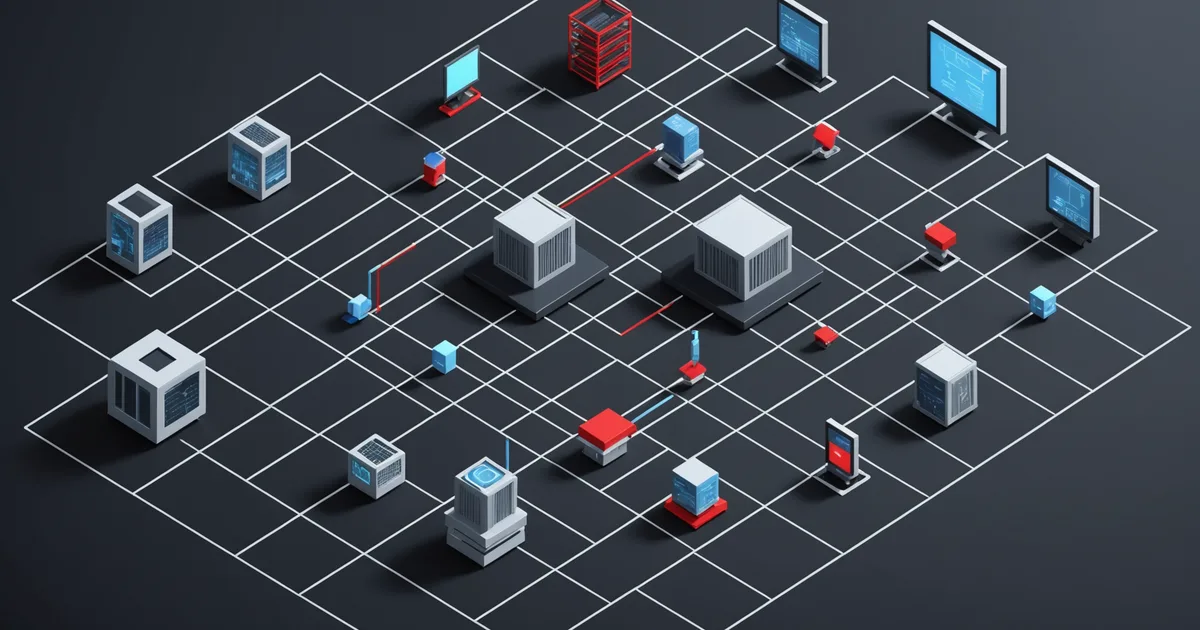

The most common debate in the first minutes of a host compromise is whether to isolate immediately or observe first. We have been on both sides of this debate. After working through a number of incidents, our current position is clear: isolate by default, collect evidence first, and treat observation without isolation as a deliberate choice that requires a written reason.
Here is why that default makes sense, and what it requires to do correctly.
What Happens in the First Two Minutes
A compromised host with active network connectivity is a problem that compounds. A ransomware process that can reach mounted network shares starts encrypting them within seconds of activating. Lateral movement tooling starts scanning the local subnet. C2 channels pull additional payloads or exfiltrate credentials. A credential-harvesting implant phones home with what it found.
Two minutes of free connectivity on a compromised host is two minutes of blast radius expansion. Most of that expansion is irreversible by the time a human engineer connects to a terminal.
The primary argument for delaying isolation is intelligence gathering: leaving the connection alive to observe C2 traffic, enumerate implant capabilities, or identify other affected hosts before the attacker knows you are responding. That is a valid tactic in specific scenarios, particularly during extended threat-hunting operations where you have time to prepare proper observation infrastructure. It is not a useful default response posture for a team responding to a live EDR alert at 2am without a pre-built capture pipeline already in place.
What Isolation Actually Stops
Network isolation at the host level, whether through an EDR quarantine, a security group change on EC2, or a VLAN reassignment on a physical host, blocks outbound connections from the compromised process. This limits:
- Data exfiltration over active connections
- C2 communication for additional payload delivery
- Lateral movement via SMB, RDP, or direct TCP connections to other hosts
- Ransomware propagation over network shares
Isolation does not stop what is already running on the local disk. An active encryption process continues encrypting local files after network isolation. Evidence on the host can still be tampered with by a process that was already running before isolation. These are important limitations, which is why isolation is not the complete response, only the correct first step.
The Evidence Problem With Delayed Isolation
Teams who delay isolation to preserve network visibility often trade forensic network evidence for compromised local evidence. A C2 channel that is running for 10 minutes while the team debates the correct response is also a C2 channel that can receive cleanup instructions. Process logs can be deleted. Prefetch files can be overwritten. File system timestamps can be modified by an active process.
The practical trade-off is worse than it looks from a theory perspective. To actually benefit from the delayed-isolation observation window, you need a network capture already running on the host or upstream switch, and you need someone actively monitoring that capture. Most lean security teams during an active incident are not in a position to instrument a network capture correctly in the first 90 seconds of response. So the observation window produces no benefit, and the extended time has allowed cleanup activity on the local host.
We are not arguing that threat intelligence and behavioral observation have no value. We are arguing that a live active incident response is not the right moment to attempt them without prior preparation. If you want observation data, set up a purpose-built deception environment or a dedicated capture host before the incident, not during it.
Automating Isolation: What Actually Needs to Happen
Automatic isolation within two minutes of a confirmed alert requires three things to work reliably.
First, the alert threshold needs to be calibrated correctly. Automatic isolation on a low-confidence alert is disruptive enough that false positives will erode trust in the system. Most EDR platforms have distinct alert severity tiers. Automatic isolation should be tied to high-confidence alerts, typically those with a high severity label and specific detection rule categories, not all alerts indiscriminately.
Second, the isolation mechanism needs to be tested before it is needed. An AWS security group modification that blocks all traffic to an EC2 instance looks straightforward but has edge cases: instances with multiple ENIs, instances using SSM agent for management that requires port 443 outbound, RDS connectivity from the instance that has operational dependencies. These need to be modeled in the runbook before an actual incident forces you to discover them.
Third, the isolation needs to be reversible and auditable. Every automated isolation action should log the original security group state so it can be restored quickly after the incident. Isolation that is difficult to reverse creates operational hesitation: teams delay isolating because they are not confident they can get the system back quickly. Reversibility removes that hesitation.
In Parachute, the EC2 isolation action captures the pre-isolation security group ID, modifies the instance to use a quarantine security group with no inbound or outbound rules except a defined management channel, and logs the original state to the incident record. Reverting is a single action with the saved state. The audit trail shows exactly what changed and when.
Isolation Is Not the Same as Containment
One clarification worth stating directly: network isolation stops the blast radius from expanding. It does not contain the incident. Containment requires understanding what happened, what was affected, and ensuring the initial access vector no longer exists.
An isolated host is still compromised. The process that was running before isolation is still there. The credentials that may have been harvested are still compromised. The vulnerability that allowed initial access is still present on other hosts in the environment. Isolation buys time to do the forensic work correctly. It does not substitute for that work.
The default-isolation posture is valuable precisely because it creates a stable starting condition. The team is not racing to contain a spreading incident while also trying to understand it. The blast radius is frozen. Now do the investigation properly.